WOUNDSENS: Turning wound dressings into smart health monitors

WOUNDSENS, one of the projects within the EIC Pathfinder: Healthcare Continuum Portfolio, is revolutionising wound care with a smart wound dressing that could inform doctors about what’s happening underneath without removing it.
These wearable dressings are embedded with biosensors to continuously monitor chronic, non-healing wounds by detecting biochemical changes directly in the wound fluid. For millions with these wounds, WOUNDSENS could mean fewer painful dressing changes, faster detection of complications, and a shift towards proactive wound management.
Turning wound checking into smart monitoring
Chronic wounds can be tough to manage because their status may fluctuate over time. Current monitoring relies on visual checks, physical assessments, and laboratory swabs. Taking a sample often requires removing the dressing, which can disrupt healing.
WOUNDSENS is working on a different solution: integrating a monitoring system into the dressing itself. The team is developing an electrospun enzymatic biosensor embedded directly into the dressing fabric. Rather than attaching a separate electronic sensor externally, the sensing function becomes a part of the textile.
WOUNDSENS' key is the combination of three areas of technology: material science, biotechnology, and microelectronics.
The team is using electrospinning, a manufacturing technique that produces extremely fine fibres, to create conductive nanofibres. These fibres can incorporate engineered enzymes that react with specific biomarkers found in wound exudate (i.e., the fluid produced by a wound), resulting in a flexible sensing material that can be integrated directly into the dressing.
This extraordinary technique could also have important implications for production. By using electrospinning as the manufacturing basis, WOUNDSENS is exploring a way to produce smart dressings at scale and with lower complexity.
But how does it work?
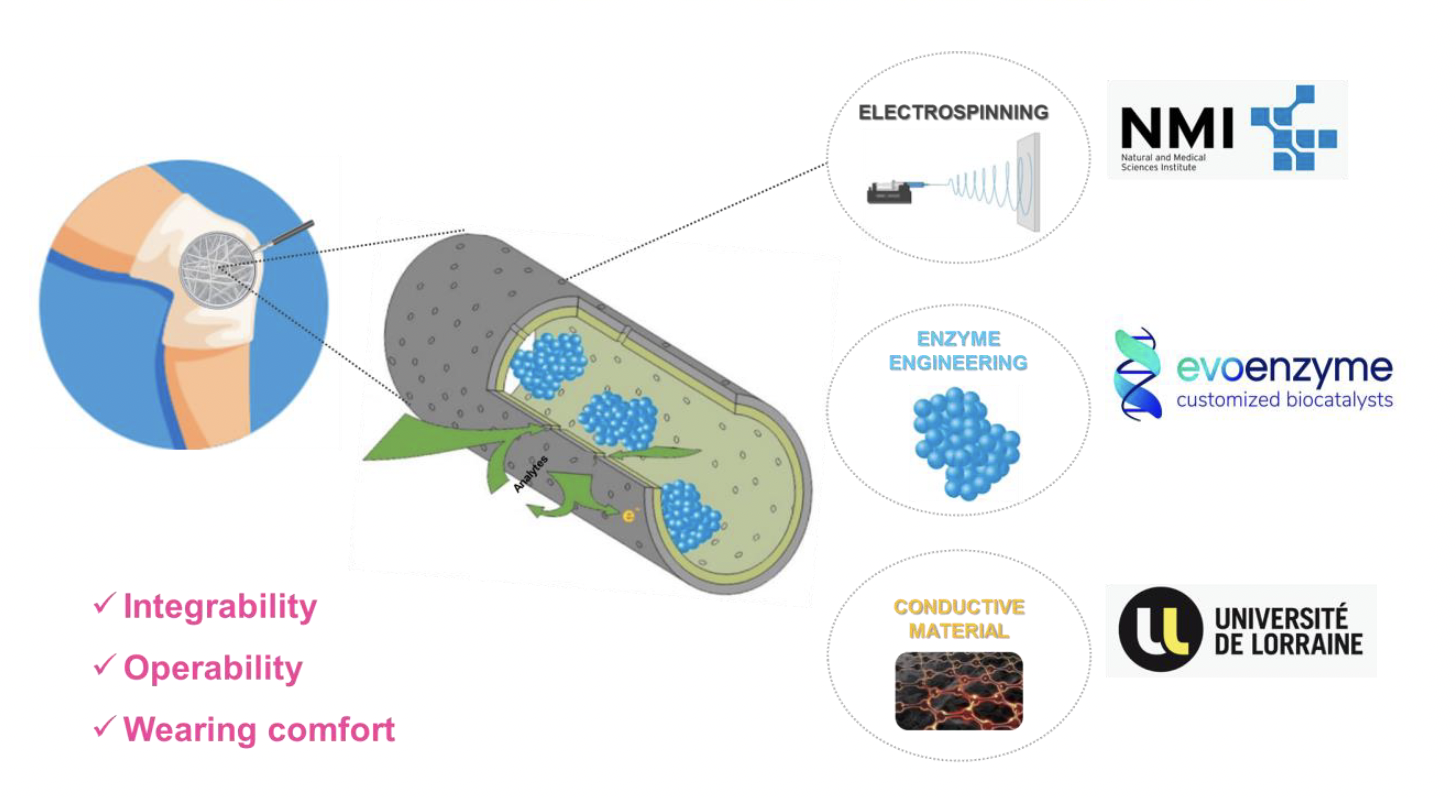
Embedding sensitive biochemical sensors into a flexible textile is far from straightforward, as a chronic wound is a challenging environment: it is moist and contains enzymes called proteases that can break down proteins. The sensors must therefore remain accurate and functional under these conditions. At the same time, the material must be biocompatible. It needs to be comfortable for the patient and should not irritate the skin or interfere with tissue repair.
The process can be broken down into three main steps:
Detecting biochemical changes: Engineered enzymes embedded within the dressing's hollow fibres interact with specific biomarkers in the wound fluid.
Converting chemistry into a signal: Conductive materials integrated into the fibres convert the resulting biochemical reaction into an electrical signal.
Monitoring without removing the dressing: The signal is transmitted to an external reader, allowing the wound's status to be monitored without removing the dressing.
In this way, the dressing could become a helpful ally, acting as a continuous interface between the wound and the healthcare professional.
Leading the way to proactive wound management
WOUNDSENS is still in the early stages of development, and the technology requires extensive further testing before clinical deployment.
Next steps include in vivo clinical trials to establish safety and efficacy, regulatory approval (including CE marking for medical devices), and scaling up the electrospinning production process.
While the way forward is challenging, the potential impact is highly significant: Instead of waiting for a wound to visibly deteriorate or removing a dressing to take a sample, healthcare professionals could eventually receive continuous information about biochemical changes taking place within the wound.
This could help identify emerging problems earlier and enable treatment to be adapted accordingly.
From smart dressings to wearable diagnostics
The ambitions of WOUNDSENS extend beyond wound care: By combining engineered enzymes, conductive nanofibres and textile manufacturing, the project is developing a platform for a new class of wearable diagnostics.
The technology is designed for scalability, with the potential to be manufactured and deployed globally if it successfully passes the necessary clinical and regulatory steps.
The consortium's longer-term ambition is to bring the technology closer to clinical use through follow-on investment and industry partnerships.
WOUNDSENS is therefore exploring a simple but powerful idea: what if the material already covering a wound could also help us understand it?
By turning a conventional dressing into a smart sensing platform, the project could help make wound monitoring less invasive, more continuous and more responsive to what is happening beneath the surface.

The WOUNDSENS consortium.
