WG2: Workshop on Portfolio Technologies, Key Problems and Opportunities
On 22nd May 2025, in Munich, as part of our Portfolio Annual Meeting, working group 2 organized our first Workshop on Knowledge Sharing and Communication. We brought together partners from across our portfolio to address a shared goal: advancing technologies that enable a radical shift from episodic healthcare to continuous health monitoring. Continuous monitoring — whether through breath analysis, wearable sensors, implantables, point-of-care devices, or AI algorithms — promises earlier detection, personalized insights, and better long-term outcomes for patients, moving care beyond traditional clinic visits into everyday life. These themes reflect wider trends in health technology, where real-time sensors and intelligent systems are increasingly central to proactive, data-driven healthcare.
In a rapidly evolving healthcare landscape, technological breakthroughs alone are not enough to drive real impact — knowledge sharing and collaboration are key. By bringing together diverse projects and perspectives, we can accelerate innovation, avoid duplicating efforts, and address common challenges through discussion, benchmarking, and cross-project learning.
In this post, you can find all the fantastic presentations from the workshop. Enjoy!
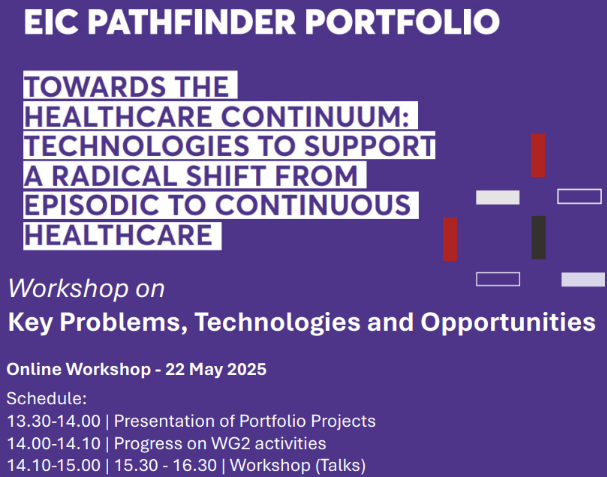
WG2 Workshop Leaflet
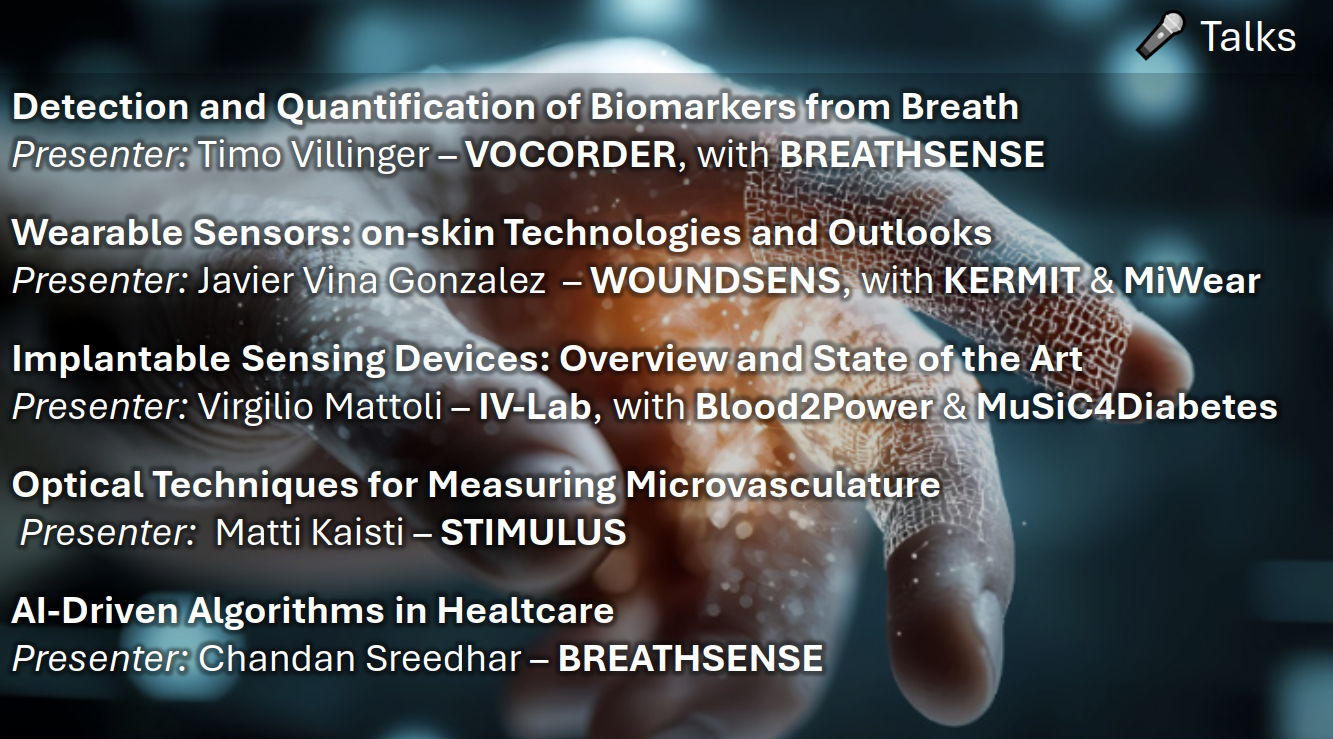
WG2 Program
T1 — Detection & Quantification of Biomarkers from Breath
Timo Villinger (VOCORDER) highlighted advancements in breath-based biomarker detection and quantification, showcasing how projects like BREATHSENSE and VOCORDER are developing non-invasive methods to capture meaningful health signals from exhaled breath. Speakers outlined the state of the art in sensor technology, discussed key challenges such as signal specificity and calibration, and emphasized opportunities for shared learning across projects addressing breath analytics.
Click to download the presentation here.
T2 — Wearable Sensors: On-Skin Technologies
Javier Vina (WOUNDSENS) provided an overview of wearable on-skin sensing technologies across the WOUNDSENS, MiWEAR, and KERMIT projects. The talk covered the main technological advantages and challenges of each initiative — from non-invasiveness and user comfort to issues around sensitivity, integration of complex sensing components, and power supply. The session also addressed environmental and physiological factors that influence measurement and underscored the importance of regulatory planning (e.g., CE marking) as these technologies mature.
Click to download the presentation here.
T3 — Implantable Sensing Devices
Virgilio Mattoli (IV-LAB) introduced the core principles and engineering challenges in the field of implantable sensing devices, focusing on work from IV-LAB and Blood2Power. Key topics included miniaturization, biocompatibility, energy management, and reliable data transmission in implantable systems. The presentation also identified common themes for cross-project benchmarking and highlighted potential collaboration opportunities.
Click to download the presentation here.
T4 — Optical techniques for measuring microvasculature
Matti Kaisti (STIMULUS) discussed the challenges of measuring microvascular hemodynamics — the flow of blood through tiny vessels that support tissue function — using non‑invasive optical techniques. Traditional methods often lack sensitivity for microcirculation, while advanced approaches aim to capture both flow and volume dynamics for richer physiological insight. STIMULUS is working on a combined HEMI‑Speckle concepts that leverage multi‑wavelength optics and speckle analysis to probe tissue layers and flow characteristics with potential for continuous, point‑of‑care monitoring.
Click to download the presentation here.
T5 — AI-Driven Algorithms in Healthcare
In the final session, Chandan Sreedhara (BREATHSENSE) explored the role of AI-driven algorithms in enhancing biosensing technologies, with examples from both BREATHSENSE and VOCORDER. The talk highlighted how machine learning frameworks are being applied to heterogeneous, low-sample-size data to extract meaningful patterns and support real-time interpretation. Key challenges were identified, and the potential for broader cross-project collaboration.
Click to download the presentation here.
