How MuSiC4Diabetes is rethinking continuous diabetes monitoring
Nowadays, diabetes is a manageable condition. However, continuous monitoring of glycaemic levels and the accurate self-administration of insulin remain daily challenges for those living with the disease.
MusiC4Diabetes aims to advance current diabetes management by making it less intrusive. The consortium is developing a smart device that integrates multimetabolite (MM) sensors with high-precision insulin delivery pumps. The goal is to provide a compact, safe, and long-lasting solution for people living with diabetes.

The problem & the technical challenge
Current diabetes therapies require patients to monitor their glycaemic levels and self-administer appropriate insulin doses accordingly. However, these processes often involve multiple daily interventions, and their effectiveness largely depends on the patient’s skills. Furthermore, current solutions do not consider other metabolism-relevant substrates such as ketones and lactate, making the information available to people living with diabetes incomplete. Their current glucose-only picture of the metabolism is incomplete, hindering optimal management of their condition. If patients are not adequately trained in managing their disease, failure to maintain proper glycaemic control can lead to serious consequences such as organ damage. As a result, patients frequently experience anxiety about hyperglycaemia or hypoglycaemia, placing a significant burden on their daily lives.
MusiC4Diabetes aims to reduce the burden on people with diabetes by introducing a state-of-the-art device that ensures near total autonomy and unobtrusiveness of diabetes management. It utilises all three critical energy-relevant metabolites (glucose, ketones and lactate) to inform automated insulin delivery algorithms.
How the technology behind Music4Diabetes works
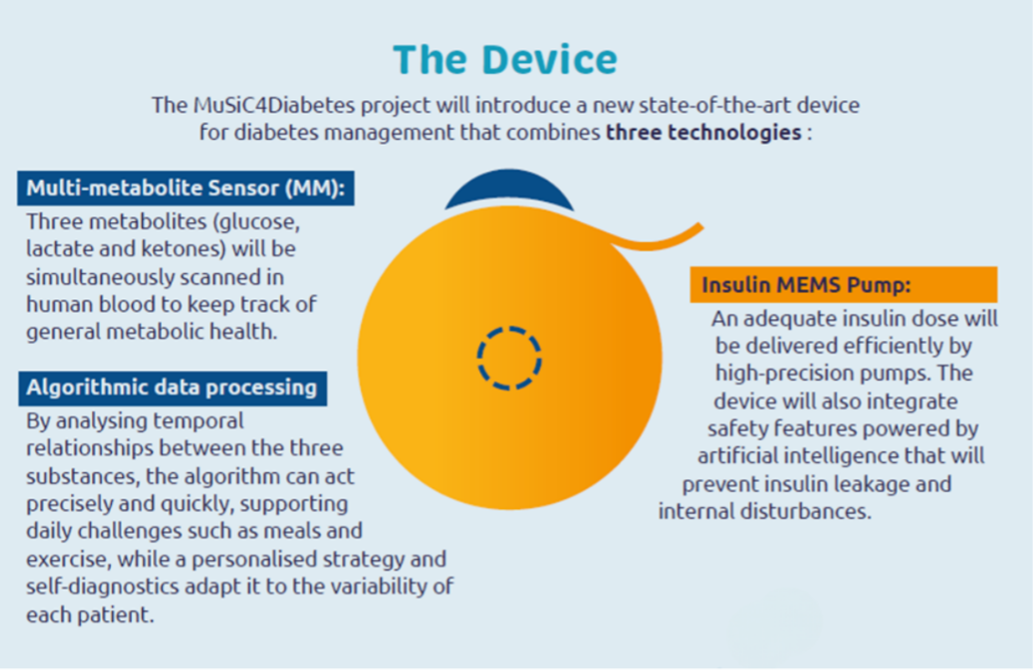
The MusiC4Diabetes device combines three core technologies: multimetabolite sensing, algorithmic data processing, and an insulin micropump. Instead of focusing solely on glycaemic levels, the multimetabolite sensor simultaneously monitors additional biomarkers such as lactate and ketones. This approach provides a more accurate picture of the energy metabolism and enables more precise treatment adapted to daily metabolic variations, such as stress or physical activity.
The temporal relationships between these metabolites are analysed in real time using advanced techniques such as machine learning. Based on this analysis, the system determines the most appropriate therapy and can dynamically adjust it in response to unexpected events. The high-precision insulin pump then delivers the appropriate dose according to the algorithm’s recommendations. In addition, the device integrates AI-powered safety features designed to prevent insulin leakage and detect internal malfunctions.
The human side
The innovative idea behind MuSiC4Diabetes is to move from glucose-only to multi-metabolite monitoring (with glucose, lactate and 3‑hydroxybutyrate), enabling a continuous physiological insulin delivery based on an advanced, adaptive, and personalised multi-target control technique. The project will enable the development of a novel, flexible, and personalised technology for diabetes treatment, based on advanced devices currently under development, such as sensors and pumps.
The main challenges faced by the project are related to the development of the sensor and pump, which must ensure accurate and reliable measurements (sensor) and accurate and precise dosing with miniaturised hardware (pump). The control algorithm must collect all relevant information and use it effectively to suggest a patient-tailored therapy that adapts to changes in the individual over time.
Data & digital infrastructure
The multimetabolite data (including glucose, lactate, and 3‑hydroxybutyrate) and clinical information about the patient are fundamental to a continuous physiological insulin delivery that is based on an advanced adaptive personalised multi-target control technique.
The clinical information will be provided to the system via a graphical interface, while continuous monitoring of the multimetabolite signals will be achieved through the breakthrough sensor under development for the project.
New machine-learning, data-driven, and adaptive-control approaches will be studied to exploit these datasets and move the paradigm from glucose-only control to multi-target control. In particular, new algorithms are under development that can detect device malfunctions, ensure safety, and optimise therapy while simultaneously considering multiple aspects.
Project impact
The MuSiC4Diabetes project aims to significantly improve the quality of life of people with type 1 diabetes. The closed-loop system developed within the project follows the principle of unobtrusive diabetes management and is designed to reduce the daily burden patients face. Routine concerns such as adjusting daily schedules or managing dietary choices will become far less demanding. In the long term, the system is also expected to be adaptable for the management of type 2 diabetes.
The consortium, comprising SMEs, clinical centres, research institutes, and universities, is focused on developing a device that is close to market readiness and capable of unlocking new market opportunities. Beyond diabetes care, the technologies integrated into the MuSiC4Diabetes device also have strong potential for broader applications, including chronic disease monitoring, treatment response tracking, and athletic performance optimisation.
Are you interested in knowing more about Music4Diabetes?
👉 Find out all about the project on their website: https://music4diabetes.eu/
